
On this page:
Preclinical modelling: the bridge from discovery to medicine
Before a potential therapy can be tested in people, researchers need reliable evidence about the disease and how an intervention is likely to behave. Preclinical modelling generates this evidence through complementary approaches, including human cells, organoids and engineered tissues, in vivo models, and computational methods. It is the critical bridge between laboratory discovery and clinical development. Better models help identify promising candidates, stop ineffective ones earlier, reduce avoidable risk, and direct investment towards treatments most likely to benefit patients.
Yet promising modelling technologies do not become trusted research tools through technical innovation alone. They also require biological expertise, disease-relevant applications, reproducible workflows, validation, and credible early users.
Turning an Australian innovation into a trusted research platform
Australian company Inventia Life Science developed RASTRUM, a 3D bioprinter manufactured entirely in Australia. In 2018, investment from Phenomics Australia- enabled the Victorian Centre for Functional Genomics, a Phenomics Australia facility at the Peter MacCallum Cancer Centre, to become the first laboratory in the world to install the system.
Placing RASTRUM within accessible national research infrastructure connected Inventia with specialist technical staff, disease-modelling expertise, cancer researchers, and early users. Together, they refined workflows, validated research applications, and supported early adoption, helping turn an emerging technology into a practical platform for preclinical research.
Australian manufacturing with global reach
RASTRUM produces consistent 3D cell models for studying disease and testing therapies in conditions that more closely resemble human tissue. It has now been adopted by eight of the world's top twenty pharmaceutical companies.
Its applications illustrate the breadth of that impact. Bristol Myers Squibb used RASTRUM to develop a scalable 3D pancreatic cancer model that recreates interactions between tumour cells and surrounding tissue and supports reproducible testing of standard and experimental therapies. Merck used RASTRUM to develop a 3D model of the brain for Alzheimer's disease research. The model revealed changes in neuronal connectivity and cell function that conventional two-dimensional cultures did not capture.
Inventia remains headquartered in Australia and has distributors in 26 countries. The result is a globally competitive technology supporting Australian advanced manufacturing and specialist capability, while helping researchers generate more relevant evidence for drug development.
Connecting the preclinical modelling ecosystem
RASTRUM demonstrates what a connected preclinical modelling ecosystem can achieve. Its success required more than an instrument. It brought together a technology developer, specialist infrastructure, model and disease expertise, application validation, research users, and downstream industry.
Phenomics Australia provided the national connecting structure through which these elements could work together. As preclinical research increasingly combines human cell models, organoids, bioprinting, and other complementary approaches, this convening role will be critical. By connecting the necessary partners and capabilities, Phenomics Australia helps technologies progress from development through validation to adoption, strengthening Australia's sovereign capability and improving the pathway from discovery to new therapies.
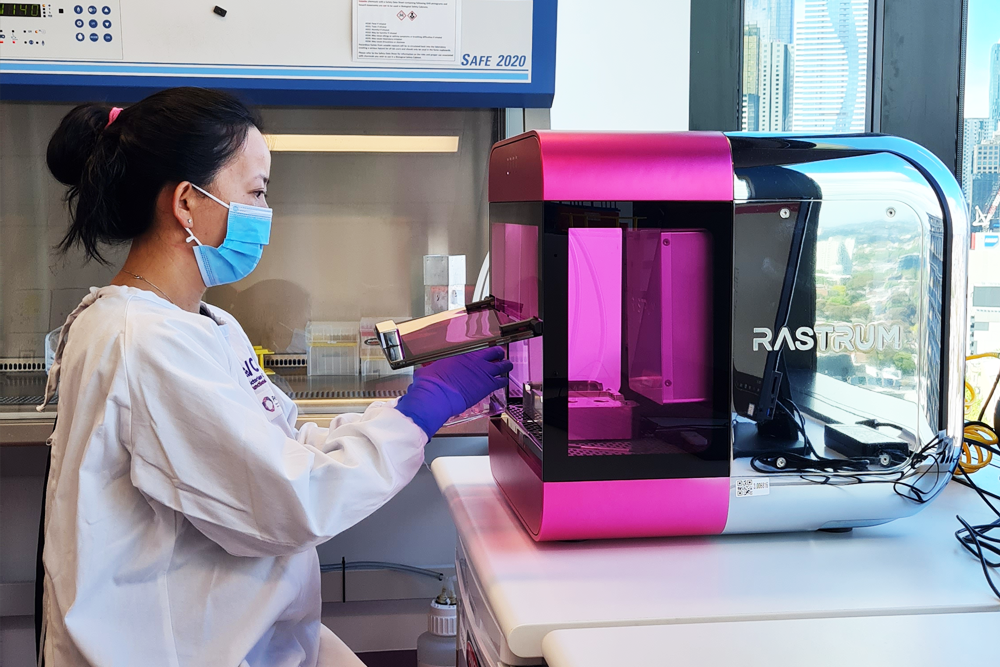
RASTRUM 3D bioprinter in action at the Victorian Centre for Functional Genomics.