
On this page:
Turning discoveries into new treatments
Polycystic kidney disease (PKD) is one of the most common inherited disorders, often leading to kidney failure and leaving patients dependent on dialysis or transplantation. Researchers at Monash University’s Biomedicine Discovery Institute and Monash Institute of Pharmaceutical Sciences identified a key cell signalling pathway responsible for the formation and growth of kidney cysts, opening the door to new therapeutic approaches.
Translating this discovery into treatments required access to Australia’s national research infrastructure. Supported by Therapeutic Innovation Australia’s (TIA) Pipeline Accelerator scheme, the team was able to advance promising therapeutic candidates towards clinical development. Additional support from Phenomics Australia is accelerating preclinical testing and helping researchers better understand how these therapies perform in disease models.
Creating new biotech opportunities
The research has led to the creation of xCystence Bio, a biotechnology company established to develop treatments that could slow or halt PKD progression. Backed by Monash Ventures, Breakthrough Victoria, Uniseed and BioCurate, the company has also secured more than $2.7 million in NHMRC and Medical Research Future Fund funding.
Beyond a single therapeutic program, the project demonstrates how NCRIS-supported infrastructure reduces barriers between academic discovery and commercial translation. By connecting researchers with world-class facilities and expertise, TIA and Phenomics Australia are helping to strengthen Australia’s sovereign capability in biotechnology and precision medicine.
Strengthening Australia’s biomedical innovation pipeline
This project highlights the role of NCRIS-enabled infrastructure in supporting government priorities to strengthen Australia’s health and medical research and innovation system. The combination of TIA’s translational expertise and Phenomics Australia’s advanced capabilities is helping to build future-facing research infrastructure while supporting the growth of new industries and highly skilled jobs.
The journey from laboratory discovery to biotechnology company illustrates how long-term investment in national research infrastructure delivers benefits far beyond the original research question—accelerating new treatments, fostering industry partnerships and building the next generation of Australia’s biomedical capability.
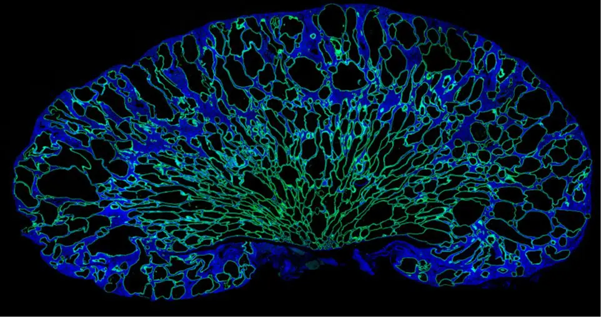
Mouse kidney with PKD
Credit: Dr Allara Zylberberg